Service Dogs in Indiana: Training, Access Rights and Where to Start

This page explains the law in general terms. It is not legal advice. For a specific situation, contact the agency listed on this site or an attorney.
A service dog can change how a person with a disability moves through daily life. Getting one is a long process. The rules around it are also easy to get wrong, because federal law, Indiana law and a lot of online noise all overlap.
This guide explains how a service dog in Indiana is defined, who qualifies, and the two main ways people end up with one. It also covers what training involves, what the programs charge, and what rights you have once you are working with a dog. It states the law as written and points you to the agencies that handle complaints. It is not legal advice.
Key takeaways
- Under the ADA, a service animal is a dog individually trained to do work or perform tasks for a person with a disability (U.S. Department of Justice, ADA.gov).
- Emotional support, therapy and comfort-only animals are not service animals under the ADA.
- There is no official service dog registry or required certification under the ADA, and Indiana law bars public businesses from requiring proof of certification, training or licensing (Indiana Code 16-32-3.5-9).
- You can get a dog from a program or train your own. The ADA does not require professional training (ADA.gov).
- Costs and waitlists vary widely, from no cost to the client to $20,000 or more. Always confirm current terms with each organization.
- Complaints about access denials go to the Indiana Civil Rights Commission (ICRC), with a 180-day deadline for public accommodations and employment.
In this guide
- What counts as a service dog in Indiana
- Who qualifies and how to get a service dog in Indiana
- The two routes: program-trained or owner-trained
- What service dog training involves
- Organizations to know, with costs and waitlists
- Your access rights in Indiana
- When something goes wrong
- Where to start
What counts as a service dog in Indiana
The federal definition
The U.S. Department of Justice, on ADA.gov, says service animals under the ADA are dogs that are individually trained to do work or perform tasks for people with disabilities. The key words are "individually trained" and "work or tasks." A dog that simply comforts its owner by being present does not meet that test.
The work can be physical or sensory. Examples include guiding a person who is blind, alerting a person who is deaf, pulling a wheelchair, or alerting to a medical event. It can also be psychiatric, such as interrupting a harmful behavior. What matters is that the dog has been trained to take a specific action, not just that it helps the person feel better.
The Indiana definition
Indiana's definition sits in Indiana Code 16-32-3-1.5. Following changes made by P.L. 230-2023 (House Enrolled Act 1354, effective July 1, 2023), it covers dogs or miniature horses individually trained to do work or perform tasks for an individual with a disability, according to the Indiana Code as reproduced by the Animal Legal & Historical Center at Michigan State University College of Law.
The older list of hearing, guide, assistance, seizure alert, mobility, psychiatric service and autism service animals was replaced by that general definition. Psychiatric service dogs remain covered if they are task-trained. The statute does not single them out.
A few Indiana laws still use older wording. The employment chapter, Indiana Code 22-9-5-9.5, still lists the older categories. The interference crime in Indiana Code 35-46-3-11.5 has its own definition. The Indiana Civil Rights Commission's public guidance describes a service animal as a dog and does not mention miniature horses. Miniature horses are handled under a separate reasonable-modification test in Indiana Code 16-32-3-1.7. For most readers, the practical focus is the dog.
What does not count
Emotional support animals, therapy animals and comfort animals are not service animals under the ADA. That does not mean they have no protection anywhere. Indiana has a separate housing law for emotional support animals, covered below. But a pet in a vest is not a service dog, and an online "registration" does not make it one.
Who qualifies and how to get a service dog in Indiana
The legal test
The ADA does not keep a list of approved conditions. A person with a disability who has a dog trained to do work or tasks related to that disability can use a service dog. The law does not set a minimum age, a required diagnosis or a required doctor's letter for public access.
Individual programs set their own rules, and those can be stricter. The Indiana Canine Assistant Network (ICAN), for example, lists these eligibility terms for its mobility dogs: live in Indiana, have a physical or cognitive disability, and be at least eight years old. Other programs have different criteria, so read each one closely.
Questions to ask yourself first
Before you start, it helps to work through a few honest questions:
- What specific tasks would a dog do for me that I cannot easily do otherwise?
- Can I care for a dog every day for many years, including costs, grooming, vet visits and exercise?
- Do I have the time and support to keep training going after the dog is working?
- Is a service dog the right tool, or would other aids or supports work better?
Your health care providers can help you think through that last question. A service dog is a working partner and a long commitment, not a quick fix.
The two routes: program-trained or owner-trained
People in Indiana generally get a service dog one of two ways. Both are legal under the ADA.
Route one: a program-trained dog
A nonprofit or training organization breeds, selects or places a dog, trains it, and matches it to a client. Many programs also train the new handler. The upside is that professionals handle the dog's early training and you work with a team. The tradeoffs are cost, eligibility rules and waiting time, which can run from months to years depending on the program.
Some programs are accredited by Assistance Dogs International (ADI). Accreditation is one way to look at a program's standards, but it is not a legal requirement for you or your dog. The VA, however, uses accreditation as a condition for its veterinary benefit, covered later.
Route two: an owner-trained dog
The ADA Frequently Asked Questions on ADA.gov state that the law does not require professional training. Handlers may train their own dogs. Many people with disabilities do this, often with help from a private trainer or a class.
The upside is control, flexibility and often a lower up-front cost. The downside is that it is hard. Not every dog has the temperament and health for service work, and a dog that washes out costs you months or years of effort. You also carry all of the training responsibility, including the public access skills the dog needs to work calmly in stores and on public transit.
Which is right for you?
A program may suit you if you want a dog selected and trained by professionals and can meet the program's eligibility rules and wait times. Owner-training may suit you if you already have a suitable dog, have the time and energy to train, and can find reliable coaching. Some people combine the two, for example by working with a program that offers owner-trainer coaching. Medical Mutts Service Dogs in Indianapolis lists owner-trainer coaching, classes and board-and-train among its services.
What service dog training involves
Service dog training in Indiana has no state-set curriculum or required hours, and the ADA does not set one either. What the law looks at is whether the dog is trained to do work or tasks and behaves well in public. Training generally has three layers.
1. Foundation behavior
This is the base: house manners, a reliable sit, down, stay and recall, walking politely on a leash, and settling quietly. It also includes comfort with handling, such as grooming, vet exams and gear. This layer starts in puppyhood or as soon as you bring a suitable adult dog home.
2. Public access skills
A service dog has to work calmly around crowds, food, other dogs, slippery floors, elevators, carts and noise. It should ignore distractions and stay under control. This matters legally as well as practically. Under Indiana Code 16-32-3.5-5 and 3.5-6, a business may exclude a service animal that is out of control or not housebroken, as long as it still offers its goods or services without the animal.
Training for this layer happens in stages. You start in quiet places and build up to busier ones, always keeping the dog successful and rewarding calm choices.
3. Task training
This is what separates a service dog from a well-behaved pet. The dog learns specific actions that relate to your disability. Depending on your needs, these might include retrieving dropped items, opening doors, bracing for balance, alerting to a sound, or responding to a medical or psychiatric cue. Which tasks fit depends on you and your disability, and your health care providers and trainer can help you decide.
Because the ADA asks what "work or task" a dog has been trained to perform, you should be able to name those tasks plainly.
Humane, reward-based methods
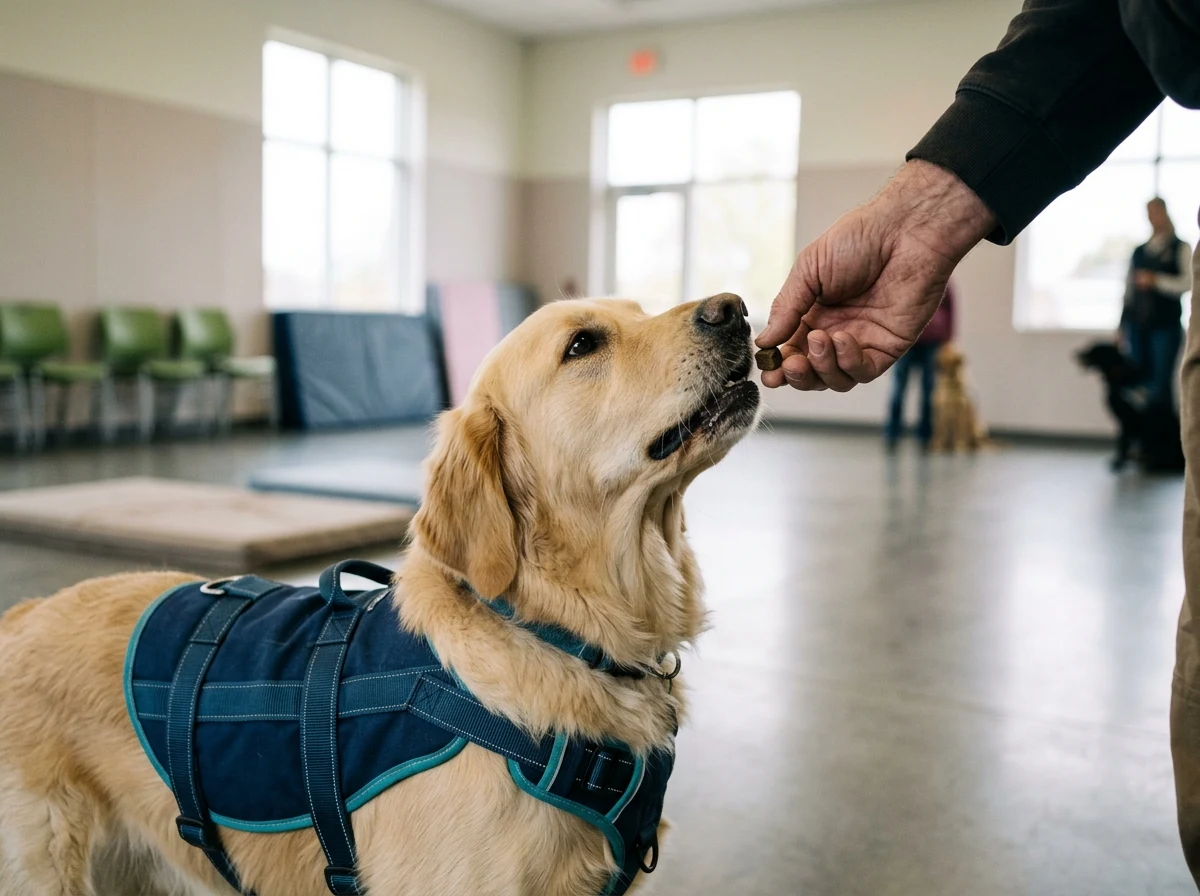
Good training is built on rewards: treats, toys, praise and access to things the dog wants. This approach is consistent with the position of the American Veterinary Society of Animal Behavior (AVSAB), which supports reward-based methods. Shock, prong and choke collars, alpha rolls, scruffing and dominance-based techniques are not part of good service dog training. They damage trust and can create fear or aggression, which is the opposite of what a working dog needs.
When you evaluate a trainer or program, ask what methods they use and ask to see them in action. Walk away from anyone who relies on force or intimidation, or who promises a guaranteed result. Training outcomes depend on the dog, the handler and the situation.
Dogs in training and the law
Indiana does address dogs still in training. Indiana Code 16-32-3-2(c) gives a service animal trainer, while engaged in the training process, the same public-accommodation access as Indiana Code 16-32-3-2 and 16-32-3.5 grant. The animal must be under the trainer's control at all times on the premises. The Indiana State Library's July 2023 summary of HEA 1354 confirms that service animals in training already had access and that the 2023 law added the trainer-control requirement.
There are limits to what the statute says. It does not define "service animal trainer." It does not say whether an owner-trainer with a disability or a volunteer puppy raiser counts as a trainer, and it does not set any age, vest or ID condition for the dog. The ICRC's public service-animal page also does not mention dogs in training. If you plan to take a dog in training into public places, check with the ICRC or an attorney about how the rule applies to your situation.
Organizations to know, with costs and waitlists
The organizations below are ones that serve or place dogs with people in Indiana. Terms change, so treat the figures as a starting point and confirm everything directly with each organization. Listing a program here is not a recommendation or a review.
| Organization | Location | Serves | Cost and wait (as published) |
|---|---|---|---|
| Indiana Canine Assistant Network (ICAN) | Indianapolis, with a Fort Wayne office | Mobility, facility, in-home skilled companion, and psychiatric assistance for veterans in the Fort Wayne area | Client fee of $2,900 against an ICAN cost to train of $32,000; no cost for honorably discharged veterans. Mobility applications are not being accepted at this time. |
| Medical Mutts Service Dogs | Indianapolis | Seizure alert, diabetic alert, psychiatric, POTS, hearing, migraine, plus owner-trainer coaching, classes and board-and-train | Check with the organization |
| Canine Companions (North Central Regional Training Center) | New Albany, Ohio; the region serves Indiana | Mobility, hearing, medical alert, veterans, facility | Free of charge, according to canine.org; check wait times with the organization |
| 4 Paws for Ability | Xenia, Ohio; serves North America | Children, autism, diabetic alert, seizure response, mobility, hearing, facility | Fee for service of $20,000 as of June 1, 2022, with an additional $3,000 for doodle, poodle or papillon; typically 1.5 to 2 years after completing the fee for service |
| Leader Dogs for the Blind | Rochester Hills, Michigan; serves the U.S. and Canada | Guide dogs and orientation and mobility | No cost to clients, including U.S. and Canada travel, room and board, equipment and instruction; check wait times with the organization |
A few notes on these programs
ICAN describes itself as the only ADI-accredited service dog training program in Indiana, and the ADI member search for Indiana lists only ICAN. That is ICAN's own claim. National programs also place dogs with Indiana residents, and 4 Paws for Ability reports ADI accreditation as of December 2025. ICAN's mobility program lists Indiana residency, a physical or cognitive disability and a minimum age of eight as its criteria.
4 Paws for Ability's veteran eligibility is described as being for local military veterans, so its reach into Indiana is mainly for children and the other groups it serves. Canine Companions and Leader Dogs are listed here as nonprofit programs. Check each organization to confirm its accreditation status and whether it currently accepts applicants from Indiana.
If you are comparing costs, remember that a program fee is rarely the whole picture. Budget for food, veterinary care, equipment, grooming and travel for training or follow-up.
Veterans
Three veteran-focused resources are worth knowing:
- VA Service Dog Veterinary Health Benefit. The VA's Prosthetic and Sensory Aids Service says the VA does not provide dogs. It pays for veterinary care and other benefits for guide dogs and for hearing and mobility service dogs, including for a mental-health-related mobility limitation, when the dog comes from an ADI or IGDF accredited program. You apply through a VA clinician and your local VA Medical Center.
- ICAN psychiatric assistance dogs for veterans. ICAN describes dogs for veterans with PTSD, TBI and military sexual trauma in the Fort Wayne area, with referrals through the VA Northern Indiana Health Care System and no cost to honorably discharged veterans.
- K9s For Warriors. This national nonprofit, based in Florida, provides trained service dogs to veterans with PTSD, TBI and military sexual trauma at no cost to the veteran.
Note the VA benefit's accreditation condition. A dog that is owner-trained or from a non-accredited source may not qualify for that particular benefit, even though the dog has full access rights under the ADA.
Your access rights in Indiana
The two permitted questions
The ADA lets staff at a business ask only two things when it is not obvious what a dog does: whether the dog is a service animal required because of a disability, and what work or task it has been trained to perform. They cannot ask about your disability, require documentation or ID, or ask for a demonstration (ADA.gov). Indiana law follows the same pattern. Under Indiana Code 16-32-3.5-9, staff may ask those two questions and may not require proof of certification, training or licensing.
Public places
Indiana Code 16-32-3.5, added in 2023, largely mirrors the ADA. According to the Indiana Code as reproduced by the Animal Legal & Historical Center:
- A public accommodation, meaning any establishment that offers services, facilities or goods to the general public, must modify its policies to permit service animals (3.5-4).
- A handler may go in all areas open to the public (3.5-10).
- A business may not charge fees or add extra requirements because of the service animal (3.5-11).
- The animal may be excluded only if it is out of control or not housebroken, and the business must still offer its goods or services without the animal (3.5-5 and 3.5-6).
- The animal must be on a harness, leash or tether unless your disability or the dog's task prevents it (3.5-7).
Refusing access or charging a fee because of a service animal is a Class C infraction under Indiana Code 16-32-3-2(b). Check the code for the current penalty amount.
No registry, no required ID
There is no official service dog registry or required certification under the ADA. No state registry, tag or ID program was found in the Indiana Code or on in.gov either. A vest, an ID card or an online "registration" is not legal proof that a dog is a service dog, and you do not need one to have your rights. If you want a vest or ID card for convenience, that is your choice, but a business cannot demand it.
Housing
Indiana Code 22-9-6-5 says a landlord may not refuse a tenant with a disability because the person has a guide dog. Housing rights for other assistance animals can involve federal housing law, which the U.S. Department of Housing and Urban Development (HUD) oversees. Contact HUD or the ICRC for how those rules apply to your situation.
Indiana also has a separate law for emotional support animals in housing, Indiana Code 22-9-7 (2018). A landlord may require written verification from a health service provider when the disability is not readily apparent (22-9-7-9), and may not charge a fee to keep an emotional support animal (22-9-7-13). Misrepresentation by a tenant or provider, including fitting a non-ESA with a harness, collar, vest or sign, is a Class A infraction (22-9-7-12). That penalty applies in housing. The research did not find a comparable Indiana penalty for misrepresenting a dog as a service dog in public places.
Employment
Indiana Code 22-9-5-20(f) and (g) say a covered employer may not interfere with the use of an animal that is, or is being specially trained as, a service animal. An employer also may not refuse to let an employee with a disability keep a service animal with them at all times at work. Employment rules can be nuanced, so talk to the ICRC or an employment attorney if you run into a problem.
Protection for the dog
Indiana Code 35-46-3-11.5 makes it a Class A misdemeanor to knowingly or intentionally interfere with, or strike, torment, injure or mistreat, a service animal while it is assisting an impaired person. It becomes a Level 6 felony if the act causes serious permanent disfigurement, unconsciousness, protracted impairment or the death of the animal. The statute includes a defense for reasonable acts of training, handling or discipline.
In practice, this is a reason to ask the public not to pet, call to or feed a working dog. Distraction can put a handler at risk.
When something goes wrong
Access denials
If a business refuses you or your service dog, stay calm and polite. State that your dog is a service animal and, if asked, answer the two permitted questions. Note the date, time, place and the names of anyone involved. If it is not resolved on the spot, you can ask to speak to a manager or leave and file a complaint later.
Where to complain
The Indiana Civil Rights Commission (ICRC) takes discrimination complaints. Its "How to File a Discrimination Complaint" page lists an online complaint portal and the phone number 317-232-2600. It says there is no cost to file. The deadlines to know are:
- 180 days for public accommodations and employment
- 1 year for housing
The Department of Justice also accepts ADA complaints through ADA.gov, and its service animal FAQ page is a useful reference.
Keep expectations realistic
Complaints take time, and outcomes vary. Filing early and keeping good notes helps. If you are unsure whether your situation is covered, the ICRC can explain what it handles.
Where to start
If you are asking how to get a service dog in Indiana, here is a sensible order of steps.
- Define the tasks. Write down what you need a dog to do. Talk it over with your health care providers so the tasks match your disability.
- Pick a route. Decide whether a program, an owner-trained dog or a mix is realistic for your budget, time and health.
- Contact programs early. Waitlists can be long, and some applications are closed. Ask each organization about current eligibility, cost, wait times and the training methods it uses. ICAN's mobility applications, for example, are currently replaced by an interest form.
- If you owner-train, find coaching. Look for a trainer who uses reward-based methods and has real experience with task and public access training. Ask for references and watch a session.
- Check veteran benefits. If you served, ask your VA clinician about the Service Dog Veterinary Health Benefit and about accredited programs.
- Learn your rights. Know the two permitted questions and the basics of Indiana Code 16-32-3.5 before you go out in public.
- Plan for the long term. Budget for food, vet care, gear and continued training. A service dog needs ongoing practice to stay reliable.
No single path is right for everyone, and no organization can promise a specific result. Take your time, ask direct questions and confirm every figure and rule with the agency or program involved. Laws can change, so check Indiana Code 16-32-3 and 16-32-3.5 on the Indiana General Assembly's site for the current text before relying on any detail here.
Sources
- U.S. Department of Justice, ADA.gov: ADA Requirements: Service Animals
- U.S. Department of Justice, ADA.gov: Frequently Asked Questions about Service Animals and the ADA
- Animal Legal & Historical Center, Michigan State University College of Law: Indiana consolidated assistance animal and guide dog laws
- Indiana State Library: Service animals in public accommodations (July 6, 2023)
- Indiana Civil Rights Commission: How to File a Discrimination Complaint
- Indiana Civil Rights Commission: Service Animals in Public Places
- U.S. Department of Veterans Affairs: Service and Guide Dogs
- Indiana Canine Assistant Network: Service Dogs Overview
- Medical Mutts Service Dogs
- Canine Companions: North Central Regional Training Center
- 4 Paws for Ability: FAQ
- Leader Dogs for the Blind
- K9s For Warriors